30 August 2011

What's In A Name? Tea Party Movement Got It Wrong

Back in 2007 or 2008, I wrote how I was upset with the current Tea Party Movement's (TPM) weak interpretation of History.  The TPM would be better served had they latched onto different special events that more accurately portray their anger, distrust and frustration with the status quo:  Shays' Rebellion or the Whiskey Rebellion (both having libertarian ideals at heart, and both having the word "rebellion" in them, which seems to be popular these days).


I've noticed that within the past year, others have inadvertently jumped on my little bandwagon.  Please note that I am not a member of the TPM, but harbor no ill will toward them.  In fact, I'm elated that people are starting to care about politics again.  My complaint is only with the name.

There are those who would quibble with my reasoning.  What's in a name?  We are describing the spirit of the original tea party, which the TPM encapsulates today!

For years after the destruction of tea in Boston Harbor, no one discussed the event.  It was too radical, and made our forebears uncomfortable.  There was little real pride in what they had done, and certainly no bragging in public houses; what pride there was paled in comparison to the fighting of the Revolution.  Today's TPM is proud.  Attempts at marginalizing this vocal political group failed, and the TPM is mentioned incessantly across the media spectrum.  It will not soon be swept under the rug of ephemera as the original destruction of tea was.


If by "spirit of the original tea party" the TPM means to say that it supports the manipulation of the emotions of the populace by wealthy people with business interests, then yes.  No true libertarian would agree with this, though.  The spirit of Shay's Rebellion shines through.  It began as a local movement of poorly treated war veterans/farmers, who were tired of being taken advantage of by business interests. Samuel Adams (a main instigator of the destruction of tea in Boston) despised this rebellion of commoners, and wrote a Riot Act, which effectively called "forth the Militia to execute the laws of the Union, suppress insurrections and repel invasions."  He also advocated for the suspension of habeas corpus, so that the frustrated farmers and veterans could be kept in jail until this little issue blew over.   The wealthy in our young country couldn't bear indignant poor people complaining about their rights. Granted, these poor couldn't pay their debts and Big Business was confiscating their lands; however, these veterans served unpaid* during the Revolution, so lacked the money to pay their debts when the war concluded (if you're stuck two states away at a military encampment, you're not earning money on your farm).


One of the TPM's favorite quotes is from Thomas Jefferson:
"The tree of liberty must be refreshed from time to time with the blood of patriots and tyrants. It is its natural manure."
This quote had nothing to do with the destruction of tea in Boston Harbor; rather, Jefferson wrote that in response to Shays' Rebellion.


Other libertarians may be more inspired by the Whiskey Rebellion (1794), which was caused by the first tax imposed on a domestic product that substantially supported Big Business and hurt local distillers (whether or not there was a conspiracy against small businesses has not been proven).  Significantly, this also led to regular citizens' growing resentment toward an East Coast that simply failed to understand their lifestyle. As historian/author Thomas Slaughter wrote, the people began equating "easterners with wealth, power and absentee landlordism, and to see local enforcers of eastern laws as self-interested lackeys of eastern elites."  Replace "eastern" with "Washington," and you'll notice this is much the language of the TPM today.  Or simply refer to historian Terry Bouton** when he simply calls the Whiskey Rebels “Regulators, citizens fed up with selfish elitist governmental economic and social policies."  Sound familiar?
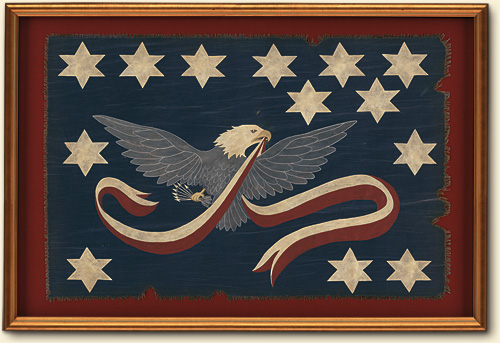

It is beyond me why a movement that views itself as here-to-stay chose to name themselves after a single night in history that was nearly wiped from public memory shortly after it occurred.  The indignant, fed-up spirit of the TPM movement is pervasive and appears to be lasting.   Is "rebellion" not a better word?


Not to mention if they ditch the name "Tea Party," they won't have to worry about all those "tea bagger" comments.


*Today soldiers freak out and post all over FB if there's even a hint they'll miss one month of pay.  During the Revolutionary War, soldiers commonly weren't paid, and during the winters didn't even have necessary supplies.  It was a different time, I suppose.
**Terry Bouton, “Tying Up the Revolution: Money, Power, and the Regulation in Pennsylvania, 1765-1800” (Ph.D. Dissertation, Duke University, 1996).

18 August 2011

Forgetting The Boston Tea Party (in brief)


"Last night, three cargos of Bohea Tea were emptied into the sea. This is the most magnificent moment of all. There is a dignity, a majesty, a sublimity, in this last effort of the Patriots that I greatly admire . . . This destruction of the tea is so bold, so daring, so firm, intrepid and inflexible, and it must have so important consequences, and so lasting, that I can't but consider it as an epoch of history."
John Adams, in his diary, December 17, 1773

On December 16, 1773, an angry mob fresh from incendiary speeches at the Old South Meeting House marched down to Griffins Wharf at Boston Harbor and witnessed a group of men dressed as Mohawks climb aboard three British ships: the Eleanor, Brig Beaver and the Dartmouth.  Without a sound, the “Indians” dumped three hundred forty-two boxes of valuable tea belonging to the East India Company overboard.[5]  According to both British and American sources, not a single box was overlooked, and the participants, as well as some onlookers, were searched to make certain no person made off with any (at least one person tried).

This destruction of property was a major crime and somewhat discomforting for England; several investigations were made into the matter.[6]  Early the next year an assembly of Loyalists from every town in Suffolk County, Massachusetts, passed a set of resolutions, one of which stated, “That no obedience is due from the province to either, or any part of the acts [of shutting up Boston Port], but that they ought to be rejected as the wicked attempts of an abandoned administration to establish a despotic government.”[7]  However, shortly after the destruction of the tea, non-loyalist inhabitants and Freeholders in Charlestown (outside of Boston) passed a resolution that they would not stand for any tea to be present in their homes, and they proposed burning all East India tea in their market square.[8]  Due to the political and economic turmoil this event created or exacerbated in the colonies, no who participated that night spoke of the event, and only one person was ever convicted of the crime.[9]
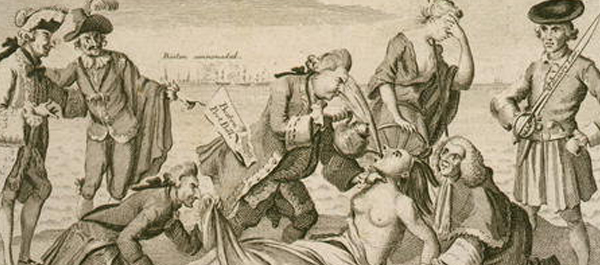
Britain's Lord North forces tea down the throat of America (represented by a female figure) in a 1774 cartoon depicting retribution for the Boston Tea Party. (Library of Congress)
The destruction of tea was encouraged, and possibly even organized, by the wealthy smugglers, who stood to lose the most by the British tax on tea in the colonies.  The American people actually benefited by the East India Trading Company's near-monopoly on importation, as it cost them approximately one shilling less from the Company for the same amount of tea.  The smugglers couldn't beat this price and still turn a viable profit.  This threat to put the smugglers out of business was enough to excite them into protest.  True, the few legitimate importers of tea also stood to lose ground, and this was technically "taxation without representation."  However, England felt she was paying for the ongoing protection of her young colony from hostile Amerindian tribes and from the rival European powers also in the Americas.

After the war, and once the United States actually achieved independence along with international recognition, such radical events leading to the Revolution were kept quiet and certainly not celebrated.  This was partly due to embarrassment, but also for fear it would incite further rebellion.  Revolutionary War veterans were ignored, Bunker Hill was leveled, and the precise location for what would later be called the Boston Tea Party was filled in and forgotten.

 “The destruction of the tea in 1773… was virtually lost in the sixty years after the Revolution as the elites who established their cultural domination chose to erase the radical or ‘popular’ side of the Revolution: the ‘mob’ actions, the farmer’s rebellions, the quest for equality.  When the event was recovered in the 1830s, it returned as ‘The Boston Tea Party,’ a name that reduced an act of civil disobedience to a comic, frivolous and safe event.”[10]  For years, many of the participants were unknown, simply because it was not something of which to be proud during its day.  By the time it was finally celebrated and allowed into public memory, most of the original participants had died, and those left failed to remember many of the names of their disguised companions.  Only with new research has this forgotten history and the names of those who lived it come to light.  [11]

Bibliography and Other Sources for Continued Reading

Alfred F. Young, “Revolution in Boston?  Eight Propositions for Public History on the Freedom Trail,” The Public Historian, Vol. 25, No. 2, (Spring 2003), pgs. 17-41.
Alfred F. Young, The Shoemaker and the Tea Party:  Memory and the American Revolution, Beacon Press, 1999.
In the Minds and Hearts of the People: Prologue to the American Revolution, 1760-1774, Washington, D.C.: Smithsonian Institution Press, 1971.
Arthur Meier Schlesinger, “Political Mobs and the American Revolution, 1765-1776,” Proceedings of the American Philosophical Society, Vol. 99, No. 4., 30 August 1955.
Massachusetts Soldiers and Sailors of the Revolutionary War, Boston, 1905, located at the Massachusetts Historical Society of 1154 Boylston Street, Boston, MA, 448-454.
Peggy Mullen, “Steeped in History:  Chest from Boston Tea Party returns to harbor to become centerpiece of new museum,” The Patriot Ledger, Boston, 6 January 2005.
McManus/Peterman Architects, “Boston Tea Party and Ship Museum: Historic Tours of America,” Architectural Plans, 19 May 2004.
“News and Opinion,” Boston News-Letter, 30 December 1773, Issue 3665, pg 2.
Sylvanus Urban, ed., “Account of the Proceedings of the American Colonies since the passing of the Boston Port Bill,” The Gentleman’s Magazine, London, November 1774.
William Price, A new plan of ye great town of Boston in New England in America with the many additionall [sic] buildings & new streets, 1769.
Sir Thomas Hyde Page, A plan of the town of Boston with the entrenchments of His Majesty's forces in 1775, from the observations of Lieut. Page of His Majesty's Corps of Engineers, and from those of other gentlemen, 1777.


[1] Arthur Meier Schlesinger, “Political Mobs and the American Revolution, 1765-1776,” Proceedings of the American Philosophical Society, Vol. 99, No. 4., 30 August 1955, pg. 245.
[2] “News and Opinion,” Boston News-Letter, 30 December 1773, Issue 3665, pg 2.
[3] Sylvanus Urban, ed., “Account of the Proceedings of the American Colonies since the passing of the Boston Port Bill,” The Gentleman’s Magazine, London, November 1774, 516.
[4] Ibid.
[5] Alfred F. Young, The Shoemaker and the Tea Party:  Memory and the American Revolution, (Boston:  Beacon Press), 1999.
[6] Alfred F. Young, “Revolution in Boston?  Eight Propositions for Public History on the Freedom Trail,” The Public Historian, Vol. 25, No. 2, Spring 2003, pg. 22.
[7] Alfred F. Young, The Shoemaker and the Tea Party:  Memory and the American Revolution.
Remainder of footnotes inexplicably cut off.  Will remedy before end of day.

11 July 2011

Lost and Forgotten Cattle Trails:

Old roads fascinate me.  I find the visual evidence of our forebearers' passing mysterious, particularly if the path is no longer in use.

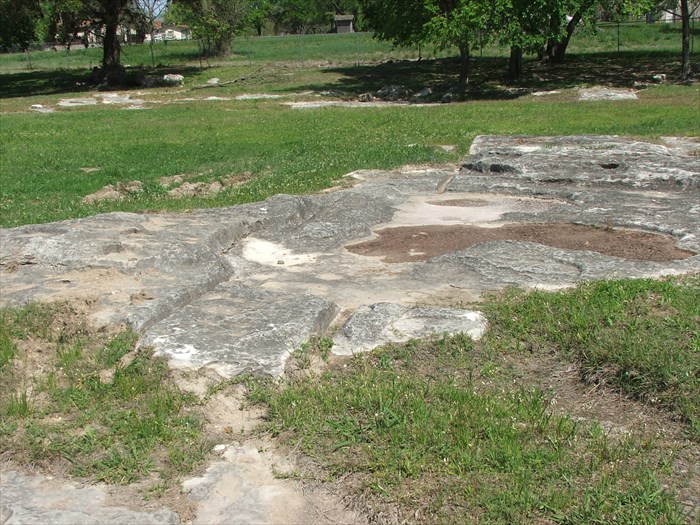
Wagon tracks carved into rocks along old Chisholm Trail near Brushy Creek, Texas.

The oldest cattle trails of the American West began in Texas, traveled through Indian Territory (later Oklahoma) and ended in Missouri.  Later trails, such as the Chisholm Trail, became popular after the Civil War, and traveled more westerly routes to Kansas.


Wagon ruts along old Chisholm Trail near Brush Creek, Texas.

The Old Shawnee Trail has had many names since the first droves meandered northeast on it in the 1830s.  Because it passed near a Shawnee village, that name stuck.  Branching off from it are other trails, including the lesser known West Shawnee Trail.  While fairly well-known in Texas due to the efforts of preservationists and local historians, not much is known about the route in Oklahoma.  Certainly it is unmarked, and seems to be relegated to brief passages in old history books.


I became interested in this particular trail because it travels through Lincoln County, Oklahoma, where my father owns a ranch.    I wanted to see if anything remains to the present day near the place where it passes only 13 miles away from Dad's place:  Stroud, OK. 

As is usual for me, I studied some old maps first.  According to the late 19th century sources (admittedly out-of-date for this early 19th century trail), it passed over the Deep Fork of the Canadian River around the Sac and Fox Agency in Indian Territory.


I noticed that even though the trail was largely out of use by cattle in the 1880s, the trails are still marked on the maps.
This indicates to me that by this point, the trails are being used for other purposes.  A path used for this long is far more likely to have remnants visible today.  I decided to check a 20th century map.

1932 USGS Stroud, OK     Map features red and white “well traveled road” heading North across Deep Fork River
This "well traveled road" followed more or less the same path as the West Shawnee Trail, even crossing the river near the same location.  In 1932, that would make the West Shawnee Trail approximately one hundred years old!  Still, does the trail exist today?  I turned to Google Maps and was only slightly disappointed.  

2011 Map of Deep Fork River bend, approximately 4 miles south of Stroud, Oklahoma (Google).  “Well traveled road” follows extant streets until meeting the river.
I added the red dashed line to help those unfamiliar with the area see where the old trail went.  The extant streets today stop short of the river on both sides.  However, this is a rural area, and the old fords wouldn't be marked on a 2011 Google Map.  Fortunately, Bing provides me with an aerial view, though the view in this area hasn't been updated/improved recently.

2011 Bing Map view of Deep Fork River bend approximately 4 miles south of Stroud.  View highlighted of probable crossing of one branch of the West Shawnee Cattle Trail.  Looks like the trail is still there!  (Thanks, Justin, for the suggestion of Bing.)

I have yet to actually travel to this area to take some photographs, but probably will within the next few months.  I'll be looking for any wagon ruts or depressions in this area indicating the exact path of travel.  While the red box marks the "well traveled road" seen in the 1932 map, I must point out that rivers are always altering course, and the cattle probably forded the river at several different locations along this bend through the years, depending upon the season/currents/shifting banks.  Spots to the east of the red box are also highly likely locations of crossing.

I queried a prominent Amerindian historian in our area (my mother-in-law), Dr. Mary Jane Warde, and she checked with her Osage friends before emailing back:  
"Another friend, Louis Burns, discusses it in his History of the Osage People. He is 91, a sweetheart and an Osage elder who grew up cowboying in Osage County and went on to be a geography professor. He and one of his grandfathers traveled the old Osage trails in a Model T noting the routes and camping places, what the names are and why. He says the West Shawnee Trail followed an old Osage trail, and you can usually trace their routes because they always went along the valleys on the left hand side of a creek or river with the current at your back."

If this is true, portions of the West Shawnee Trail are hundreds of years old - certainly something worth remembering and marking in our relatively new state!  While I find it frustrating that Oklahoma has failed to preserve some of its most interesting pre-statehood history, I also recognize the opportunity to investigate some history on my own, which is both enjoyable and rewarding. I know I'm not the only historian who would like Oklahoma's sections of the Old Shawnee Trail to land on the National Register of Historic Places. 

20 May 2011

The Devil whispered behind the leaves, "It's pretty, but is it Art?"

Being an expert in one thing does not automatically make one an expert in other things.  Most of us are aware of this.  Apparently Roger Ebert is not one of those people.  The article entitled "Video Games Can Never Be Art" has been brought to my attention more than once over the past year.  Most recently, it appeared on a Facebook friend's profile, who specifically asked me to comment.* 
And comment I did.

Ebert's first mistake is this: "No one in or out of the field has ever been able to cite a game worthy of comparison with the great poets, filmmakers, novelists and poets.  To which I could have added painters, composers, and so on, but my point is clear."  (No, I don't know why he said poets twice.)

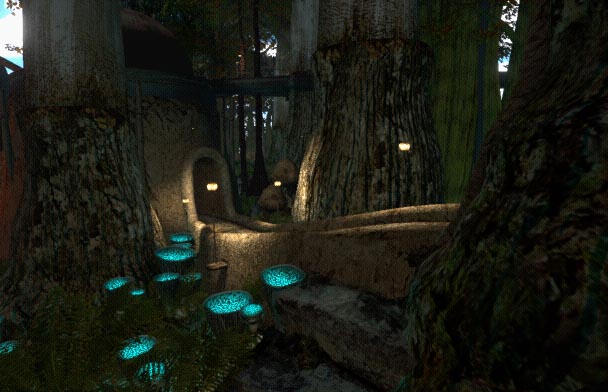
I don't think Ebert ever played Myst...

What field?  If he means the video game field, that is a lie.  If he means the art world, that is also inaccurate.  If he means the Movie Critic Field, he may be correct, because a person in that field has no reason to say it.  I doubt any person in the molecular biology field has said it either.


Too ugly.  Not art.

It seems that in this article, Ebert imposes the arbitrary and unnecessary limit of Mastery on Art; i.e., it has to be exceptional to earn the title. Anyone who has become immersed in one of the Final Fantasy Games (my brother cried when Sephiroth killed Aeris) knows video games have the ability to be emotional, engaging, beautiful... and become art if their creators intended Art, or the players perceive it to contain artistic merit. 
Ever played Myst? Riven? Those are the epitome of Art in a video game! 


Ebert quotes from classical greats, "Plato, via Aristotle, believed art should be defined as the imitation of nature. Seneca and Cicero essentially agreed."  The concept that art needs to imitate life has been outdated since... I don't know, the Art Deco movement? Before? Dali's/Picasso's works deviate from a mirror of this world, yet most consider them master artists.  (Ebert also cites Wikipedia, which anyone who has attended college in the last decade can tell you is never admissible in an academic argument.)  He goes on to ask, "Does art grow better the more it imitates nature? My notion is that it grows better the more it improves or alters nature through an passage through what we might call the artist's soul, or vision."  
And he doesn't think video games accomplish that very goal?


This involved zero artistic talent or human imagination.


I've said before and repeated ad nauseum: "Art is that which is created, and perceived to be as such."**
 
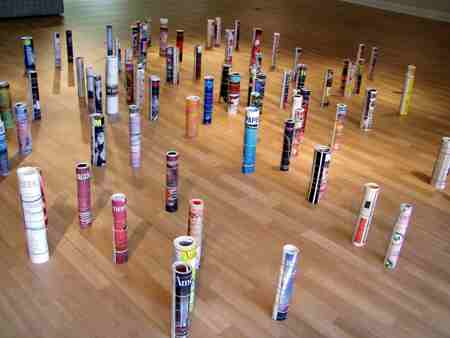
I don't like the signed urinal in MoMA, but there it is - an artistic creation. I don't like most installation art, due to its great deviation from the norm (and I can't put it in my house), but it is still art. 


My FB friend mentioned to me that relying on my definition of art is difficult, as "art" doesn't really mean anything.  I'm inclined to agree the word "art" doesn't have much of a meaning.


Nuts and bolts are typically not considered Art, but all it takes is someone to find a bunch of them, fill a bucket, sign it, and stick it a modern art museum and TA DA!  Art! 

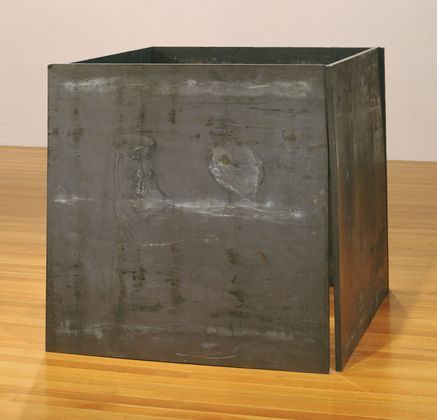
This is a box. Kind of.  (Richard Serra, 1969)


I look at the word "Art" as I view the words "Matter" (applies to most things) and the word "Things" (also nebulous). "Art" as a word is only slightly more specific... though not much. That's why those in the art world have categories such as Classical Art, Modern Art, Contemporary Art, Photographic Art, Installation Art, Graffiti Art, Sculpture (Classical or Modern), various artistic movements (Hudson River School, Art Nouveau, whatever shit Andy Warhol repackaged, etc).

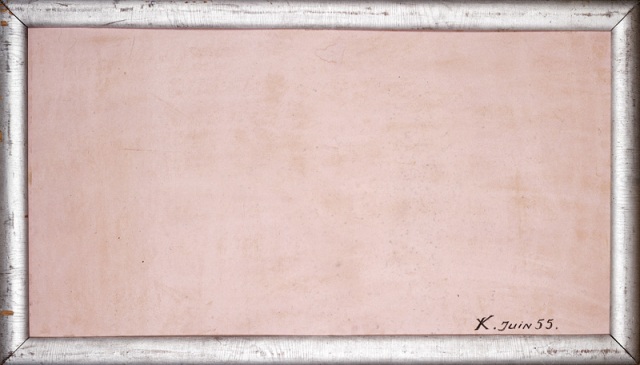
 Yves Klein, Monochrome rose sans titre (MP 55), 1955

You may think, "So art can be anything!"  Of course it can.  Think of it from a photographer's perspective.  A good photographer sees beauty in the mundane, and captures it, creating Art.  The dew drop on a leaf wasn't art until the photographer "created" it.  Video games are creations, and any one who has played a Final Fantasy game was either wowed by the story or by the graphics.  To say that the incredible combination of the two wasn't Art is ludicrous.


Ebert's article was written by someone who has little experience in the professional art world outside of cinema (either in a museum, or as an appraiser, or an artist), so the entire article is a nice uninformed opinion with pretty pictures. 
I won't try to be a movie expert, and he should leave Art alone.


*I am not a gamer.  I play games seldom and sporadically.
**For proof, click link. 
Title is from Rudyard Kipling (thank you, Alex, for the reference):
When the flush of a new-born sun fell first on Eden's green and gold,
Our father Adam sat under the Tree and scratched with a stick in the mould;
And the first rude sketch that the world had seen was joy to his mighty heart,
Till the Devil whispered behind the leaves, "It's pretty, but is it Art?"

22 April 2011

Avoid Discount Stores, Save Money

Most people I know like to keep a nice home, but are uncomfortable spending a lot of money to do it.  Furniture, lighting and accessory purchases can add up quickly, even if purchased from cheap places such as Pier OneIkea or (God forbid) Walmart.  Obviously a person saves a lot of money buying a $30 table from one of these stores; however, the down side to these places is the quality of the product, meaning that when a struggling grad student or single mom decides to sell the pieces at a garage sale or eBay, s/he is unlikely to get much, if anything, back.  Overall, purchasing this type of furniture or decor is a poor investment.

 Do not support the communists..

So what's a cost-conscious person to do?  Are we relegated to pizza-box couches?

Buy vintage.

Before you think you can't afford it, or wonder why on earth you'd want to, think about this example:  I bought a small solid wood used bookcase at a garage sale for $25.  I used it for a couple of years, until I moved across the country.  It was not cost-effect to pay to ship it, so I decided to sell it.  I put it at my own garage sale for $25, and took $20.  I essentially "rented" that bookcase for only $5 for a couple of years.  Another small bookcase I'd purchased from Walmart for $18 only sold for $3.  Paying $300 for an antique buffet may seem like a lot of money, but go to a nice furniture store and check the prices on new ones.  In addition, if you have to sell the antique, you are more likely to get your money back.  

 This lighted cabinet is currently on craigslist for $20. 

Most lamps I own are vintage.  I choose vintage over antique because the wiring is usually in working condition, and vintage lamps tend to be less expensive and delicate than antiques.  If I ever have to sell them, I'll probably recoup my losses, or even make money.  A 1950s cattail-inspired lamp I nabbed at auction in western New Jersey for $25 has sold on eBay for over $200.  I bought a grass-green 1960s adjustable lamp at the Salvation Army for $3, and I use it at work.  It looks great, is unique, and I doubt I would have found the same thing at Target at double the price.

 Check out this awesome hanging light I scored off eBay yesterday for less than $50.

Decor can be an even better bargain.  Eclectic blown-glass vases, vibrant pottery, figurines and fascinating wall art may all be bought on the secondary market, and for a fraction of the cost of original retail.  Check out your local antique gallery, thrift shop or eBay/Craigslist for great stuff to make-over your living space.  The best part of buying antique or vintage is that it is different.  Walmart churns out millions of the same little decorative thingy, so buying that $9 thingy to "personalize" your apartment is ridiculous.  You have the same thingy as millions of others, making you just as special as every single other schmuck who also bought it.


Mid-20th century West German vase.

Be stylish and unique.  Be eco-conscious. Buying pre-owned on eBay or at a garage sale is helping that young couple buy their first house, and keeping something from a landfill.  Buying bronze bookends from your local antique dealers supports small business.  Buying a ceder chest from the woman's shelter resale shop supports their cause.  

 Nothing starts a conversation quite like light-up grapes.

Bottom line - you've made an excellent addition to the aesthetic appeal of your home, as well as a great financial decision.  And you'll be living with a little bit of history. 

23 March 2011

27 January 2011

Don't Get Scammed: Use Common Sense

I’ve written about fakes before, since I consider finding one both exciting and annoying.

They are exciting because some detective work is usually necessary to figure out that it is a fake (rather than an anomaly, or just a reproduction), and they are annoying because trying to explain to someone they have a fake can be tedious.

“But the dealer swore he took that from Martha Washington's grave himself!”

“The guy who sold it to me said it was all original - now you say the running boards are repro?!”

I try to tell people to research something before buying it. Most people find research off-putting in that they believe such an endeavor is overwhelming. “Goodness, I’m no historian! How will I know if it’s real? I’ll just buy it and hope for the best.”

This is partially true – a connoisseur is much more knowledgeable about a specific product than a novice. Appraisers understand market dynamics and different types of value. Museum curators are immersed in their field, and are excellent (usually) unbiased resources. For some forms of authentication, a scientist is required (for example, dendrochronology, paint analysis, carbon dating).

So yes, hiring a professional is always best; however, if the piece doesn’t warrant that level of expertise, or you only have a passing interest, doing your own research can be as easy as putting both your brain cells together. Here’s my basic starter guide to determining the authenticity of anything:

Google it.

Some things, such as Dali prints, are faked so often that it’s laughable. Most appraisers go into a project involving Dali prints expecting some (if not all) to be fake. Heck, eBay has it's own article on fake Dali prints. The signatures are wrong, the numbering of the print is wrong, etc. Park West Gallery on cruise ships had a particularly bad habit of selling these (only in international waters, of course). Using Google to see what others have written on the subject is quick, easy, and free. Certain cars and vintages of wine are also faked.


Common Sense.

Use what knowledge you already possess. I was cataloging the impressive collection of a certain museum last year, and came across a small cup and saucer that purportedly was unearthed after being buried for 400 years. The cobalt decoration was poorly executed, and the bottom of the cup was clean. By “clean,” I mean that my 9 month old coffee cup at work has a dingier bottom than this very antique archaeologically-recovered tea cup. It was obvious that this was, in fact, not a genuine piece (and as it turns out, the person from whom the museum acquired the piece was a shady character anyway).

If something seems “odd” or “funny,” then it probably is.


Not the actual cup.

Recently a person bought table that he swore was antique. “Look how old it is! I think it must be at least from the 1920s.”[ii] Upon further inspection, all screws were Phillips-head, and didn’t appear to be replacements. Phillips-head screws were not available until the 1930s.[iii]

Plausibility.

Sometimes you know the object is probably not fake, but you want to know if the it is original, rather than a reproduction or something fabricated “in the style of.” One must delve a little deeper into the background of the object, rather than focus on the object itself. Were they making that style of chair in Virginia before the Civil War? Did that bottling company ever use anything other than green glass?

A woman once emailed me claiming to have some silver than had been passed down in her family for 500 years. I quickly learned that the company who made the silver had only been in business since the 18th century. Obviously no special dating or knowledge of silver hallmarks was required, as the company did not exist 500 years ago. Her silver was not “fake;” rather, it was simply not as old as she was telling everyone.

One way of quickly figuring out that something is suspicious is discovering that there were more sold than there were originally made. A good example of this was detailed in this excellent article in the New Yorker:

In some cases, the bottle, the label, and the capsule all appeared genuine, but the rarity of the wine alone was ground for suspicion. Koch owns two magnums of Lafleur from 1947, for instance. “Forty-seven is the great Lafleur,” Molyneux-Berry said. But, he continued, he has heard that in 1947 the vineyard bottled only five magnums. “What’s the chance of him having two out of five?” he asked. Edgerton maintains an online database that tracks auction sales and prices. Nineteen magnums of ’47 Lafleur have sold at auction since 1998.[i]


If after performing your own research, you still think you might have something special, please consider hiring a professional to learn more, including how and if you should sell it, or the best method of storing/displaying/preserving it.

Great article discussing wine, fraud, appraising, and why Christie’s Auctions can’t always be trusted: http://www.newyorker.com/reporting/2007/09/03/070903fa_fact_keefe#ixzz1CFt62UEK


[i] A Reporter at Large, “The Jefferson Bottles,” The New Yorker, September 3, 2007, p. 106.

[ii] Note: Unless we are discussing rugs or cars, the word “antique” ONLY applies to items 100 years old, or older. For items younger, the term “vintage” would be appropriate.

[iii] Popular Science, January 1936, page 38.