27 January 2012

Pocket Full of Posies: The Black Death in Art

There was not just one "black death," and it was not called the Black Death until the 1830s. Europeans simply knew it as the "pestilence."

It wiped out entire towns, and ended up killing around half the population of Europe. (We used to believe it killed 1/3, but the error of this number has been realized within the last decade.) The effect of such an event (or series of events) dramatically changed medieval society. True, Spanish Influenza actually killed more people; however, the main difference is that a larger portion of the population was affected in the 1340s than in 1918, and people in the 20th century had an idea of what was happening in that they were aware of "germs." In the 14th century, people fought over whether the disease(s) was caused by "bad air," wells poisoned by Jews, God's anger, one of the four horsemen, etc. These poor people must have been terrified to see their family and friends dropping swiftly around them,* with no idea as to why, or if they will be next. 


This sudden impact on population and psyche took its toll on religion, politics, social order and (lesser known) on Art.
 
The pestilence killed several contemporary artists, particularly in Italy. "...Ambrogio Lorenzetti and Pietro Lorenzetti died in the first out break of 1348. Later plague epidemics took the lives of Andrea del Sarto, Titian, Dosso Dossi, and the greatest Venetian genius of all time, Giorgione." [source] This alone impacted the thriving art world.

Those remaining artists altered their subject matter. Prior to this outbreak, Jesus was commonly depicted as a great King who came to save us. A golden halo usually surrounds his head, as well as the heads of the saints. 


13th century, Serbian Monestary Hilandar, Mt. Athos
 
After the plague, Jesus transformed into the suffering, dying Christ that we see in many European Churches. He wore a bloody crown of thorns and had a hemorrhaging, pierced side. 
Italian, mid-14th century, Met Museum Collections
The rest of the art world was not spared from the onslaught of Death. It permeated the paintings in the form of tortured people, skeletons, demons, the "danse macabre" [dance of death] and other unpleasant figures.
"Hellmouth," Simon Marmion, 1475    

Etching, ca. 1360

To these mediaeval people, it seemed no one was immune from God's wrath. Poor people died as well as those of noble blood, such as Princess Joan who died en route to marry the future King of Castille.
Royal Library of Belgium

Even the men of God were not spared. This frightened the populace for two reasons: 1) The people saw that God failed to save those supposedly most faithful to God; and 2) The religious folk at the time were also the doctors. If even the doctors couldn't save the people, and prayer failed, what could be done?
Monks with plague, late 14th century illuminated manuscript

Mattias Grunewald, Bridgeman Art Library

The fears of the people shook them to their core, and were reflected in their art (and even personal hygiene - people stopped taking baths for a few centuries, because they felt that bathing opened the pores and allowed in the bad air). For a glance at the Black Death's effect on religion, go here.


Why Are Today's Women Unhappy?

According to a recent study, women today are less happy than they were 40 years ago, and are less happy than men. 
Official Happiness Meter, courtesy of the Carebears.


This study by "economists Betsey Stevenson and Justin Wolfers... indicates that across race, marriage status, economic bracket, and even country, women's subjective experience of being happy has declined both absolutely and in relation to men."

Putting aside the fact that economists decided this, and not someone who is actually trained in handling human emotion, this is sobering news.  With all our liberation and freedom, how can the happiness levels of women be less than in the 1960s?  

And what do men have to be so happy about?
Fair enough.

Religious folks will tell you that all this liberation has taken women away from our purpose in life, which is to care for the home and hearth while the man is at work.  We should have a couple of babies (more than a couple, if you're Catholic or Baptist), and work hard to raise them.  This is what Nature and God intended.  To deviate from this path is to bring about our own unhappiness.


In a New York Times editorial about this same study, the conclusion was a bit different.

"There's no necessary reason why feminists and cultural conservatives can't join forces -- in the same way that they made common cause during the pornography wars of the 1980s -- behind a social revolution that ostracizes serial baby-daddies and trophy-wife collectors as thoroughly as the 'fallen women' of a more patriarchal age."

He suggests that it is in fact the fault of Men that Women are so unhappy.  Think about it - men made out like bandits in this age of sexual liberation!  Want regular, socially acceptable sex?  Don't get married; just get your girlfriend to move in with you.  Bored with your 40 year old wife/mother of your children?  Trade her for two twenty-year-olds.  Knock a girl up?  Don't marry her, and don't worry about the baby's life complicating your own.  After all, the best form of birth control is not using your real name. 


Yet as much fun as it is to blame men for all female ills, I just can't agree in this instance.  Yes, there are men out there who are jerks.  To suggest that all women are less happy today because of a few bums is unfair to men.  This view is also unfair to women, as it implies that our happiness is dependent upon men (when my happiness is obviously dependent upon shoes).


Personally, I believe that our unhappiness is self-imposed. 

For the most part, American women tend to believe that they must do the following in order to be considered a complete and successful woman:
 

  • I HAVE to get married.
  • I HAVE to have a career.
  • I HAVE to have children.
  • I HAVE to look good while doing it (exercise, eat well, wear the right clothing, keep a nice house).

But it's more than merely what I think about myself.  If any woman is lacking in any of the aforementioned departments, then all the other hens sit in judgment. 

"Sally and her husband haven't had kids yet.  Do you think there's something wrong with her?"

"Omg, Julie has 3 little girls, and all she does is work.  What kind of mother leaves her kids at day care for someone else to raise?"

"Honey, you're almost 35 and you're still not married.  Are you at least seeing anyone? There's this nice man from church that I want you to meet..."


Supposedly, modern females in this country have "choices."  However, I noticed we tend to place limitations and expectations on each other without any help from men.  I can't tell you how many times I've been told how selfish I am because I don't want kids, or how I'll "change my mind in time."  I thought Woman's Rights and the Pill allowed me to have reproductive freedom.  
I guess not. 

What about women who actually want to be housewives? Some women are perfectly happy to care for the home and for their children while their husband works.  "Progressives" will say that those women live under a misogynistic husband, have been socialized to think this is their correct path, and are too weak to stand up for themselves. 


"Choice" to some feminists means "Choice as long as you do what I think you should do."  

Women are judged by other women for having children and keeping the career, for not having a career and staying home, for not having children.... the list goes on.

This is why we're unhappy.  It is our own fault.

30 November 2011

What Makes Humans So Special?

[ranked 7th on MySpace in early 2008 when it was cool]

On another blog, someone made the claim that humans are superior to all other creatures because of our ability to piece together sentences. I would simply say, "language," but other animals (notably chimps) are also able to communicate wants and feelings in a way that humans can understand. No, this person said that we were better merely because of our grammar.

I had a decent response, but for some reason no one responded to my comment.
[insert overused sound of crickets chirping]

I then decided to pose the question to you for two reasons:
1) Most of the readers of this blog are well-read and/or educated.
2) All of you are extremely opinionated – some to a fault. ?

What makes a Human superior to all other forms of life?

Is it our ability to use tools?


Is it bipedalism [ability to walk upright]?


Is it the ability to mourn, and understand the loss of our own?


Is it our language that sets us apart?


 Why do we think that just because an animal doesn't communicate the same way as we do, that it is a lesser being?


Though perhaps they don't speak with "proper grammar" in OUR language, we know exactly what they are saying.


What about people who cannot speak – are they not as special as the rest of us?


What about people who cannot even sign? Those who were not born with the facilities necessary to communicate on the complex level of other humans – are they not as special as the rest of us?


It can't be our religion that makes us special. Some humans do not possess religion, but some elephants do. Some hypothesize that Neanderthals had religion, but we know they were not actually human.

It can't be our ability to love. Not all humans do that, unfortunately, but many animals do. Swans mate for life (they seem to be doing better than 51% of America).

It can't be our ability to vocalize. Nearly all animals can make noises expressing surprise or fear or aggression.

The only thing that sets us apart from the rest of animal kingdom would be our DNA. However, even a mouse shares most that with us. Though that makes us different than other species, how does it make us better?

22 November 2011

The Offense of Christmas Trees:

I recently saw a friend vent online about how he was upset that a store labeled their trees "holiday trees."  Whatever religion you are (or aren't), you probably call it a "Christmas tree."  Even my Jewish friends put up Christmas trees.  They really have no religious affiliation.  Yet not calling them "Christmas trees" may be more historically accurate, and not for the common notion that the tradition was originally pagan (like many aspects of this season).


Christians haven't always liked celebrating Christmas, particularly American Christians.  What is today one of the most holy of holidays was largely ignored or frowned upon. Early Christians did not observe Christmas at all.  Puritans, starting with Oliver Cromwell, preached against the "heathen traditions surrounding this sacred event."  These austere beliefs traveled with our much-revered Pilgrims over to the New World.  In 1659, the General Court of Massachusetts fined people for hanging decorations; in fact, any observance of 25 December outside of church was outlawed. Not until the mid-19th century was Christmas finally made a legal holiday in Massachusetts. There is no mention of the Christmas tree in the United States prior to the 19th century.*


Concerning the tree itself, those of more orthodox faith point to Jeremiah 10:2-4:
2Thus saith the LORD, Learn not the way of the heathen, and be not dismayed at the signs of heaven; for the heathen are dismayed at them. 3For the customs of the people are vain: for one cutteth a tree out of the forest, the work of the hands of the workman, with the axe. 4They deck it with silver and with gold; they fasten it with nails and with hammers, that it move not.

Some websites believe this passage speaks more about idolatry, but if adorning a tree with expensive decorations and lights then placing it in a focal point of the home and surrounding it with presents isn't "excessive devotion"...


Nothing excessive about that.
There are those people today, such as my friend, who are upset that "Christmas" is being removed from the celebration of the season.  These angry people usually attribute it to the non-existent War on Christmas - this new evil brought about by liberals and their lawyers, by pagans and atheists.  Truthfully, there is nothing new here.  As previously mentioned, Puritans felt the heathens were ruining the sacred commemoration of Christ's birth with their frivolous decorations; even in 1885, popular publication Harper's Magazine ran an article discussing how some were worried that soon the holiday could become burdened by "all the excessive gifts and artificial social observances."


No room left at the inn, or under the tree, for Jesus.

Perhaps the most appropriate way for a Christian to celebrate the birth of Christ is in quiet reflection as in days of old - without the distractions of gifting, drinking, feasting and decorating.  Truly, referring to a decorated fir as a simple "holiday tree" may be more respectful of the nativity.

In addition, we can also stop hearing the ol' "Real or Fake Tree?" argument. 

[fake is better]


*Most agree that the German immigrants brought it to Pennsylvania; from there, the idea spread.

28 October 2011

As If You've Seen A Ghost:

I have never (to my knowledge) seen a ghost. I don't know that I've heard one. However, I do know several otherwise normal friends who firmly believe they've interacted with the supernatural. Therefore, I believe that there must be something to their stories.

Do they have active imaginations, or is there something creepier to blame?

I'm sure everyone here has seen a Ghost Photograph. Generally, this consists of a photograph of a graveyard with weird lights, or a shadowy face in a window of a rambling old house. These days I'm reluctant to trust ghost photographs because PhotoShop is so user-friendly.

Then an idea struck me - what about antique or vintage ghost photographs?

Here are some that I've found. Sometimes double exposure could be the cause, but there are others where such an explanation doesn't make sense.


Look in the back seat.


Famous old ghost photograph of "Brown Lady of Rayham"


This one was originally deemed to be a double exposure, but then someone discovered that the women didn't take any photographs of young children on that roll of film.


And here's my favorite, because it's the least likely one to have been faked (though I'm always open to any scientific explanation):


Taken in 1919, this ghost photo of a RAF squadron from World War One has an extra ghostly face in the picture. It is believed to be Freddy Jackson, an air mechanic who had been accidentally killed by an airplane propeller two days before the pic was taken. His funeral took place on the day the photograph was shot. Members of his air squadron recognized his face with ease and believe he must have shown up for the haunted picture, unaware he had passed. Freddy's ghostly apparition appears behind the airman in the top row, fourth from the left.


What do you think?

14 October 2011

More Than Decoration: The Humble Pumpkin

As the moon waxes full over the scattered frost of the yard during these crisp October mornings, one's mind wanders to the warm colors and spicy flavors of Autumn.  In the United States, the pumpkin is the quintessential element of Fall decorating and baking.  But why limit our gourd to pies and lanterns one time each year?  Our ancestors found a multitude of uses for this versatile plant.
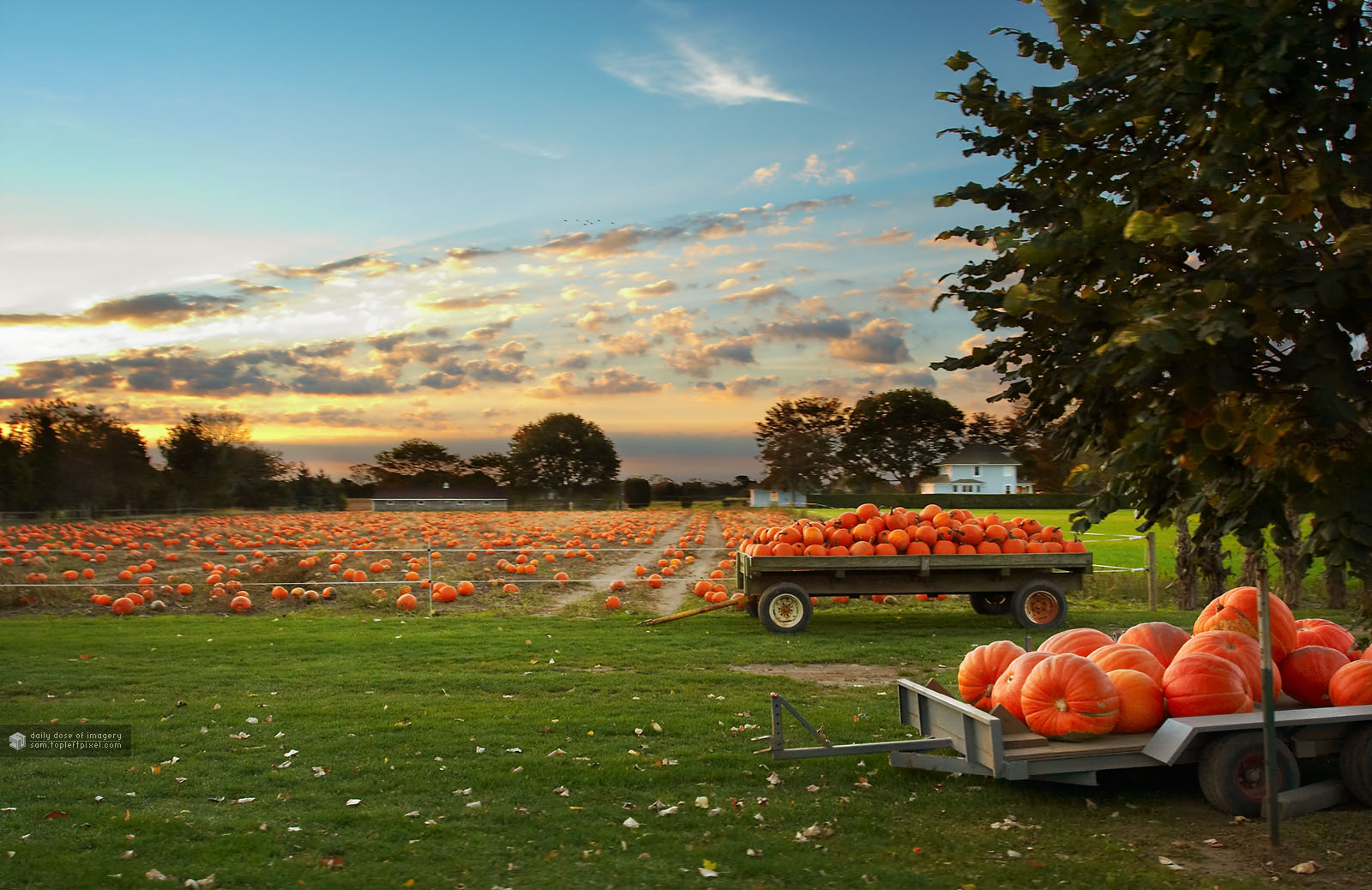
Gathering Pumpkings: An October Scene in New England, ca. 1860
Pumpkins, like many of our favorite vegetables, originated in North America and cultivated by American Indians for thousands of years.  Prehistoric peoples created two lineages of the gourd; one was grown in Mexico, and the other, considered a subspecies by some, along the east coast of the United States.  The pumpkin was roasted over fire, and pieces were pounded into strips to create mats.  

Pumpkins prefer warm, moist environments, and the first Spanish explorers likely encountered them in Florida and Central America.  They named them calabaza, and by the early 1700s both black and white farmers around St. Augustine, Florida, were actively growing them (may have been as early as late 1500s).
  

The English settlers brought with them to the New World their custom of carving squash into lanterns. These settlers, both Spanish and English, consumed pumpkin raw, roasted, cooked in a stew or soup. Some of the first European colonists filled the pumpkins with honey, cream and spices, then set them in the fire to cook.  This may be the origin of pumpkin pie.  During the late 1700s and early 1800s, New England farmers fattened cattle, hogs and horses on pumpkins during the winter, though they advised to place some salt on the flesh first, otherwise the animals may not find it appetizing.


La Récolte des citrouilles à la Bastide de Malvalat by François Marius Granet (1775-1849), 1796

Instead of pottage and puddings and custards and pies,
Our pumpkins and parsnips are common supplies;
We have pumpkins at morning and pumpkins at noon,
If it was not for pumpkins we should be undone.

Poem from 1630, published in the Collections of Massachusetts Historical Society, 1838


Medicinal uses:  
  • In a 2007 study, pumpkin was found promote regeneration of damaged pancreatic cells.  
  • The seeds also contain omega-3 fats and zinc, which may promote prostate health.


Here's my recipe for simple pumpkin soup.  Feel free to share your own pumpkin recipe.  


3 tbsp. butter
2 cups cubed fresh pumpkin
1 tsp. salt
1 tbsp. sugar
1/4 tsp. nutmeg
1/4 tsp. ground pepper
3 cups chicken broth
1/2 cup fat free half and half.


I cook the pumpkin in a pan (to soften it), then place all the ingredients in a blender (I'm sure a food processor works as well). I then return it to the pan to continue simmering for about 20 minutes. Some people pour the soup back into the pumpkin and bake for a little while - it keeps the soup warm.


Most of my sources are from the 17th, 18th and 19th centuries, and are a fascinating read for those interested in the history of our country's agriculture.