If you celebrate Columbus Day, you celebrate death and destruction.
I've been saying this for years, but some people still don't get it.
My argument isn't so much that he paved the way for killing millions of people, or began the transatlantic slave trade; rather, I'm more upset that we celebrate some guy who didn't really do anything.
Along 5th Ave in New York City, the Italian Americans will be holding their annual Heritage fest. I don't knot why Italian Americans choose Columbus as their symbol of pride instead of, say, an Italian who did something useful (Amerigo Vespucci anyone? You know, the guy for whom two continents are named?)
How ridiculous is the celebration of Columbus?
Myth 1: Columbus proved the world was round.
Um, people knew that the world was round for quite some time. It casts a circular shadow on the moon during a lunar eclipse, and sailors had always recognized that land disappeared over the horizon when sailing away from it. They didn't think that their loved ones and home cities fell off the planet, only to magically reappear again once the sailors came back home.
I've been saying this for years, but some people still don't get it.
My argument isn't so much that he paved the way for killing millions of people, or began the transatlantic slave trade; rather, I'm more upset that we celebrate some guy who didn't really do anything.
Along 5th Ave in New York City, the Italian Americans will be holding their annual Heritage fest. I don't knot why Italian Americans choose Columbus as their symbol of pride instead of, say, an Italian who did something useful (Amerigo Vespucci anyone? You know, the guy for whom two continents are named?)
How ridiculous is the celebration of Columbus?
Myth 1: Columbus proved the world was round.
Um, people knew that the world was round for quite some time. It casts a circular shadow on the moon during a lunar eclipse, and sailors had always recognized that land disappeared over the horizon when sailing away from it. They didn't think that their loved ones and home cities fell off the planet, only to magically reappear again once the sailors came back home.

Myth 2: Columbus discovered the Americas.
Putting aside the fact that the natives here already knew about themselves, Columbus wasn't the first European. He probably wasn't the second. There are dozens of stories of sailors getting blown off course and coming into contact with unfamiliar lands. Not to mention, archaeologists have found proof of Viking settlements in Canada. There's also the book entitled 1421 claiming that the Chinese also "discovered" America, but most historians don't really buy it.

Artifacts from Viking settlement L'Anse aux Meadows. Housed at the UNESCO World Heritage Viking Museum.
Myth 3: Columbus set foot on what would later become the United States.
Not until his 3rd voyage did he reach mainland, and even then it wasn't North America. He did land on Puerto Rico – so perhaps if one stretches it, that could be considered landing on U.S. soil. But I won't give him credit for it.

The guy who actually stepped ashore first (after millions of Amerindians): Ponce de Leon, 1513. His descendants still reside in St. Augustine, FL.
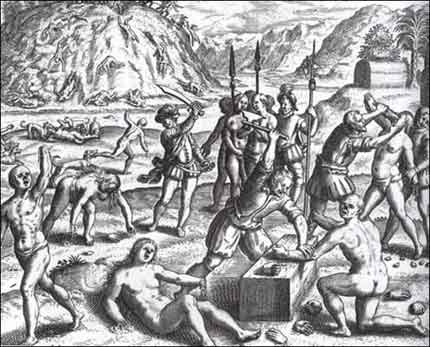
I don't mind that Italian Americans celebrate their heritage. But why choose someone who didn't land in this country, who didn't discover anything, who exterminated an entire people (the Arawaks) and who essentially screwed up the whole point of his mission?
Glenn Spagnuolo, an Italian-American, said Columbus' legacy should not be celebrated.
"To honor someone who, by his own writings, was a slave trader, is immoral," he said. "I don't see any of my Italian culture in celebrating the occupation and destruction of native cultures."

The order of people to arrive in the "New World" is the following (and is admittedly ever-changing according to new archaeological evidence):
- First wave of Amerindians.
- Second Wave of Amerindians.
- Possibly the Ainu people of Japan (see Kennewick Man, 9,000 years BP having Caucasoid features) and possibly stone age Europeans, who came across on ice shelves (according to spear point analysis, and DNA analysis of the Ojibwa peoples)
- Inuit peoples.
- Vikings, in several voyages.
- Christopher Columbus in 1492, but he didn't land on any mainlands.
- Ponce de Leon landed in Florida in 1513. Founded no settlement.

So why do we insist upon naming a day after him?


