Showing posts with label Fine Art. Show all posts

27 January 2012

Pocket Full of Posies: The Black Death in Art

There was not just one "black death," and it was not called the Black Death until the 1830s. Europeans simply knew it as the "pestilence."

It wiped out entire towns, and ended up killing around half the population of Europe. (We used to believe it killed 1/3, but the error of this number has been realized within the last decade.) The effect of such an event (or series of events) dramatically changed medieval society. True, Spanish Influenza actually killed more people; however, the main difference is that a larger portion of the population was affected in the 1340s than in 1918, and people in the 20th century had an idea of what was happening in that they were aware of "germs." In the 14th century, people fought over whether the disease(s) was caused by "bad air," wells poisoned by Jews, God's anger, one of the four horsemen, etc. These poor people must have been terrified to see their family and friends dropping swiftly around them,* with no idea as to why, or if they will be next. 


This sudden impact on population and psyche took its toll on religion, politics, social order and (lesser known) on Art.
 
The pestilence killed several contemporary artists, particularly in Italy. "...Ambrogio Lorenzetti and Pietro Lorenzetti died in the first out break of 1348. Later plague epidemics took the lives of Andrea del Sarto, Titian, Dosso Dossi, and the greatest Venetian genius of all time, Giorgione." [source] This alone impacted the thriving art world.

Those remaining artists altered their subject matter. Prior to this outbreak, Jesus was commonly depicted as a great King who came to save us. A golden halo usually surrounds his head, as well as the heads of the saints. 


13th century, Serbian Monestary Hilandar, Mt. Athos
 
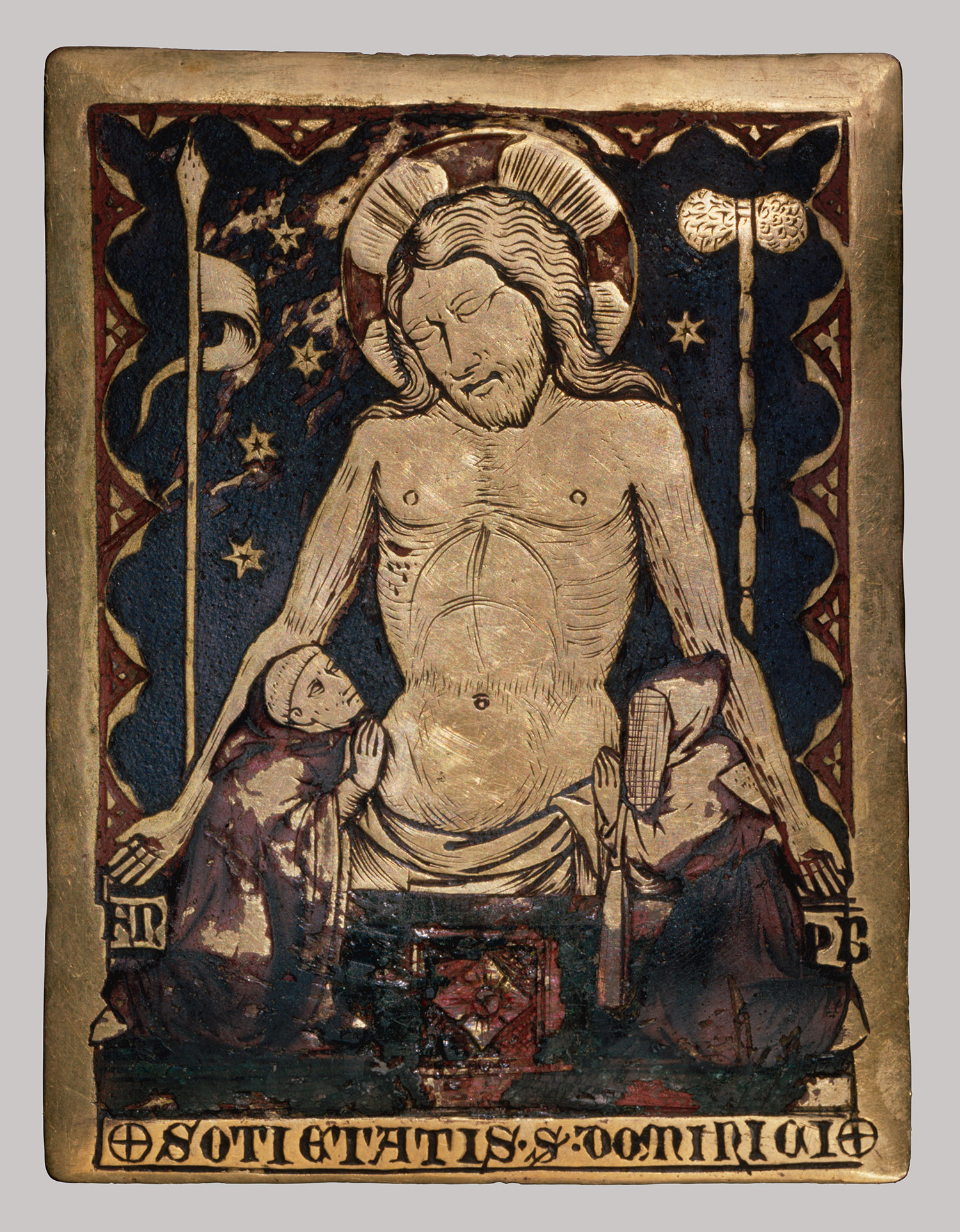
After the plague, Jesus transformed into the suffering, dying Christ that we see in many European Churches. He wore a bloody crown of thorns and had a hemorrhaging, pierced side. 
Italian, mid-14th century, Met Museum Collections
The rest of the art world was not spared from the onslaught of Death. It permeated the paintings in the form of tortured people, skeletons, demons, the "danse macabre" [dance of death] and other unpleasant figures.
"Hellmouth," Simon Marmion, 1475    

Etching, ca. 1360

To these mediaeval people, it seemed no one was immune from God's wrath. Poor people died as well as those of noble blood, such as Princess Joan who died en route to marry the future King of Castille.
Royal Library of Belgium

Even the men of God were not spared. This frightened the populace for two reasons: 1) The people saw that God failed to save those supposedly most faithful to God; and 2) The religious folk at the time were also the doctors. If even the doctors couldn't save the people, and prayer failed, what could be done?
Monks with plague, late 14th century illuminated manuscript

Mattias Grunewald, Bridgeman Art Library

The fears of the people shook them to their core, and were reflected in their art (and even personal hygiene - people stopped taking baths for a few centuries, because they felt that bathing opened the pores and allowed in the bad air). For a glance at the Black Death's effect on religion, go here.


20 May 2011

The Devil whispered behind the leaves, "It's pretty, but is it Art?"

Being an expert in one thing does not automatically make one an expert in other things.  Most of us are aware of this.  Apparently Roger Ebert is not one of those people.  The article entitled "Video Games Can Never Be Art" has been brought to my attention more than once over the past year.  Most recently, it appeared on a Facebook friend's profile, who specifically asked me to comment.* 
And comment I did.

Ebert's first mistake is this: "No one in or out of the field has ever been able to cite a game worthy of comparison with the great poets, filmmakers, novelists and poets.  To which I could have added painters, composers, and so on, but my point is clear."  (No, I don't know why he said poets twice.)

I don't think Ebert ever played Myst...

What field?  If he means the video game field, that is a lie.  If he means the art world, that is also inaccurate.  If he means the Movie Critic Field, he may be correct, because a person in that field has no reason to say it.  I doubt any person in the molecular biology field has said it either.


Too ugly.  Not art.

It seems that in this article, Ebert imposes the arbitrary and unnecessary limit of Mastery on Art; i.e., it has to be exceptional to earn the title. Anyone who has become immersed in one of the Final Fantasy Games (my brother cried when Sephiroth killed Aeris) knows video games have the ability to be emotional, engaging, beautiful... and become art if their creators intended Art, or the players perceive it to contain artistic merit. 
Ever played Myst? Riven? Those are the epitome of Art in a video game! 


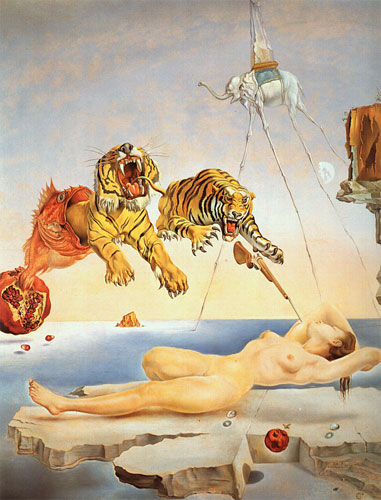
Ebert quotes from classical greats, "Plato, via Aristotle, believed art should be defined as the imitation of nature. Seneca and Cicero essentially agreed."  The concept that art needs to imitate life has been outdated since... I don't know, the Art Deco movement? Before? Dali's/Picasso's works deviate from a mirror of this world, yet most consider them master artists.  (Ebert also cites Wikipedia, which anyone who has attended college in the last decade can tell you is never admissible in an academic argument.)  He goes on to ask, "Does art grow better the more it imitates nature? My notion is that it grows better the more it improves or alters nature through an passage through what we might call the artist's soul, or vision."  
And he doesn't think video games accomplish that very goal?


This involved zero artistic talent or human imagination.


I've said before and repeated ad nauseum: "Art is that which is created, and perceived to be as such."**
 
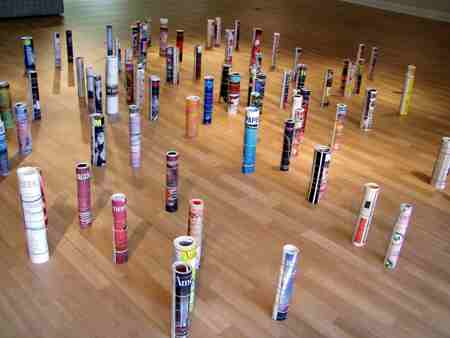
I don't like the signed urinal in MoMA, but there it is - an artistic creation. I don't like most installation art, due to its great deviation from the norm (and I can't put it in my house), but it is still art. 


My FB friend mentioned to me that relying on my definition of art is difficult, as "art" doesn't really mean anything.  I'm inclined to agree the word "art" doesn't have much of a meaning.


Nuts and bolts are typically not considered Art, but all it takes is someone to find a bunch of them, fill a bucket, sign it, and stick it a modern art museum and TA DA!  Art! 

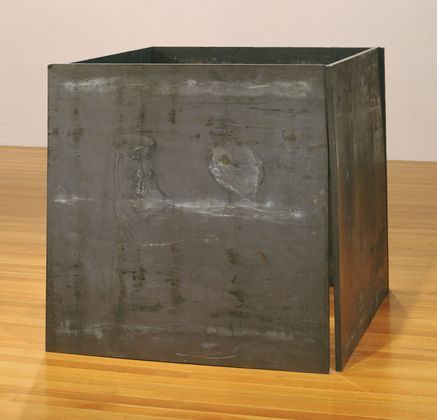
This is a box. Kind of.  (Richard Serra, 1969)


I look at the word "Art" as I view the words "Matter" (applies to most things) and the word "Things" (also nebulous). "Art" as a word is only slightly more specific... though not much. That's why those in the art world have categories such as Classical Art, Modern Art, Contemporary Art, Photographic Art, Installation Art, Graffiti Art, Sculpture (Classical or Modern), various artistic movements (Hudson River School, Art Nouveau, whatever shit Andy Warhol repackaged, etc).

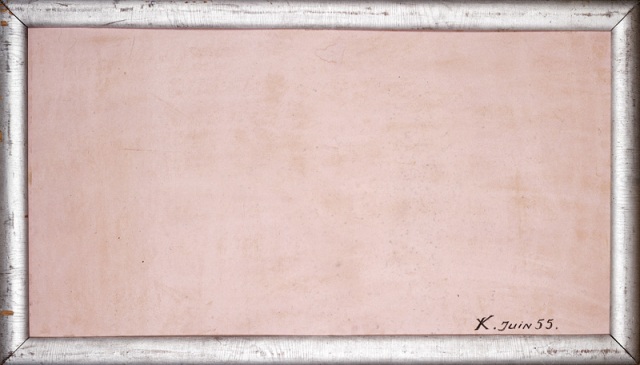
 Yves Klein, Monochrome rose sans titre (MP 55), 1955

You may think, "So art can be anything!"  Of course it can.  Think of it from a photographer's perspective.  A good photographer sees beauty in the mundane, and captures it, creating Art.  The dew drop on a leaf wasn't art until the photographer "created" it.  Video games are creations, and any one who has played a Final Fantasy game was either wowed by the story or by the graphics.  To say that the incredible combination of the two wasn't Art is ludicrous.


Ebert's article was written by someone who has little experience in the professional art world outside of cinema (either in a museum, or as an appraiser, or an artist), so the entire article is a nice uninformed opinion with pretty pictures. 
I won't try to be a movie expert, and he should leave Art alone.


*I am not a gamer.  I play games seldom and sporadically.
**For proof, click link. 
Title is from Rudyard Kipling (thank you, Alex, for the reference):
When the flush of a new-born sun fell first on Eden's green and gold,
Our father Adam sat under the Tree and scratched with a stick in the mould;
And the first rude sketch that the world had seen was joy to his mighty heart,
Till the Devil whispered behind the leaves, "It's pretty, but is it Art?"

27 January 2011

Don't Get Scammed: Use Common Sense

I’ve written about fakes before, since I consider finding one both exciting and annoying.

They are exciting because some detective work is usually necessary to figure out that it is a fake (rather than an anomaly, or just a reproduction), and they are annoying because trying to explain to someone they have a fake can be tedious.

“But the dealer swore he took that from Martha Washington's grave himself!”

“The guy who sold it to me said it was all original - now you say the running boards are repro?!”

I try to tell people to research something before buying it. Most people find research off-putting in that they believe such an endeavor is overwhelming. “Goodness, I’m no historian! How will I know if it’s real? I’ll just buy it and hope for the best.”

This is partially true – a connoisseur is much more knowledgeable about a specific product than a novice. Appraisers understand market dynamics and different types of value. Museum curators are immersed in their field, and are excellent (usually) unbiased resources. For some forms of authentication, a scientist is required (for example, dendrochronology, paint analysis, carbon dating).

So yes, hiring a professional is always best; however, if the piece doesn’t warrant that level of expertise, or you only have a passing interest, doing your own research can be as easy as putting both your brain cells together. Here’s my basic starter guide to determining the authenticity of anything:

Google it.

Some things, such as Dali prints, are faked so often that it’s laughable. Most appraisers go into a project involving Dali prints expecting some (if not all) to be fake. Heck, eBay has it's own article on fake Dali prints. The signatures are wrong, the numbering of the print is wrong, etc. Park West Gallery on cruise ships had a particularly bad habit of selling these (only in international waters, of course). Using Google to see what others have written on the subject is quick, easy, and free. Certain cars and vintages of wine are also faked.


Common Sense.

Use what knowledge you already possess. I was cataloging the impressive collection of a certain museum last year, and came across a small cup and saucer that purportedly was unearthed after being buried for 400 years. The cobalt decoration was poorly executed, and the bottom of the cup was clean. By “clean,” I mean that my 9 month old coffee cup at work has a dingier bottom than this very antique archaeologically-recovered tea cup. It was obvious that this was, in fact, not a genuine piece (and as it turns out, the person from whom the museum acquired the piece was a shady character anyway).

If something seems “odd” or “funny,” then it probably is.


Not the actual cup.

Recently a person bought table that he swore was antique. “Look how old it is! I think it must be at least from the 1920s.”[ii] Upon further inspection, all screws were Phillips-head, and didn’t appear to be replacements. Phillips-head screws were not available until the 1930s.[iii]

Plausibility.

Sometimes you know the object is probably not fake, but you want to know if the it is original, rather than a reproduction or something fabricated “in the style of.” One must delve a little deeper into the background of the object, rather than focus on the object itself. Were they making that style of chair in Virginia before the Civil War? Did that bottling company ever use anything other than green glass?

A woman once emailed me claiming to have some silver than had been passed down in her family for 500 years. I quickly learned that the company who made the silver had only been in business since the 18th century. Obviously no special dating or knowledge of silver hallmarks was required, as the company did not exist 500 years ago. Her silver was not “fake;” rather, it was simply not as old as she was telling everyone.

One way of quickly figuring out that something is suspicious is discovering that there were more sold than there were originally made. A good example of this was detailed in this excellent article in the New Yorker:

In some cases, the bottle, the label, and the capsule all appeared genuine, but the rarity of the wine alone was ground for suspicion. Koch owns two magnums of Lafleur from 1947, for instance. “Forty-seven is the great Lafleur,” Molyneux-Berry said. But, he continued, he has heard that in 1947 the vineyard bottled only five magnums. “What’s the chance of him having two out of five?” he asked. Edgerton maintains an online database that tracks auction sales and prices. Nineteen magnums of ’47 Lafleur have sold at auction since 1998.[i]


If after performing your own research, you still think you might have something special, please consider hiring a professional to learn more, including how and if you should sell it, or the best method of storing/displaying/preserving it.

Great article discussing wine, fraud, appraising, and why Christie’s Auctions can’t always be trusted: http://www.newyorker.com/reporting/2007/09/03/070903fa_fact_keefe#ixzz1CFt62UEK


[i] A Reporter at Large, “The Jefferson Bottles,” The New Yorker, September 3, 2007, p. 106.

[ii] Note: Unless we are discussing rugs or cars, the word “antique” ONLY applies to items 100 years old, or older. For items younger, the term “vintage” would be appropriate.

[iii] Popular Science, January 1936, page 38.

13 September 2009

To Buy Or Not To Buy (And Why):

In most of my blogs that have dealt with fine art or antiques, I always say that the best investment is to buy what you like. That way, if for some reason you can't sell it, you won't be upset by having it hang on your wall, or sit in your corner indefinitely.


Some people think that only listed artists are valuable, or that only antiques are valuable.

These people are mistaken.

Something is an "antique" if it 100 years old or older. People love to tell me their grandmother's 1940s bed room suite is "antique." It isn't.

It is also a vague term, and has little to do with money. Many antiques are not particularly valuable. I was researching a Victorian ivory handled, silver plated fish service last week that was quite disappointing in its value (and my standards are pretty low).

Conversely, people will pay a lot of money for nearly anything that Andy Warhol touched.


Freeman's sold an Andy Warhol (1928-1987) Grace Kelly for $50,000 last November, which was actually below estimate.

Plenty of unlisted artists do well, depending upon subject matter. An unsigned oil on canvas of a beautiful river scene is never worthless.

But don't feel you should be limited to what hangs on a wall, or a shiny flatware service.

Here is what is sitting out in front of the gallery where I worked in New Jersey:


This could be yours, for the low low price of $325. And it plays the Lone Ranger song. How can you refuse??

I was reading an article, and saw that 1980s Pez dispensers can be worth $125-$150, and some rather bland looking "first generation" Pez dispensers can bring as much as $1,500 (but the article failed to mention if that was an auction value or a retail value - kind of important info).


The important part of buying a vintage or antique piece is to at least know a little something about it.
More than once we've had to appraise fake Dalis and Chagalls. Even on my cruise boat they were selling them - they are everywhere (
Park West is the name of the cruise-ship auction house to be avoided.) People purchase them with the impression that they are investments for the future.

Like all investments, you need to do some research first or hire an expert to work on your behalf. How many of you would spend your life savings in the stock market without speaking with a broker or other qualified consultant? I mean, that's kind of why we antiques appraisers are here.


Even the tiniest fraction of knowledge will help you when spending your money. Is that tea set sterling silver, or just plate? But if it is plate, is it good plate? Is that table a genuine period piece, or nice reproduction? Why is it so cheap?

As for me, my newest interest is to collect post WWII West German pottery. Most of it may be had for less than $100, and even the good stuff is less than $200. If it increases in value, that's great! If it doesn't, that's okay because I will have only bought items I like, and I didn't spend too much.


Happy buying!

Ranked Number 1 in Jobs/Careers on MySpace, 5/19/2009 and 5/20/2009.